DIY Website vs. Custom Website: When Is It Time to Invest?
One of the biggest questions I hear from wellness professionals is whether they should build their own website or hire a professional. The answer isn't always one or the other—it depends on where you are in your business journey. Practically speaking, every successful wellness business starts somewhere, and a DIY website is often the right first step because it's a smart and budget-friendly approach.
Fore example, I remember DIY'ing my first website when I was working as a virtual assistant. The brand colors were pretty, subtle, and warm. The messaging was welcoming. My portfolio showcased the versatility of my services, and the design was created using an easy drag-and-drop process. There were no bells and whistles, but it got the job done! After all, the goal is progress, not perfection, right?
Over time, I was reminded of one of my favorite expressions: the only constant in life is change. I adored that first website and was proud of the work I had put into it. However, my design skills were growing behind the scenes, and I was becoming more aware of the audience I wanted to serve and, more importantly, why. As a result, my website needed to evolve—just as yours will likely need to evolve alongside your wellness business.
Where Are You in Your Website Journey?
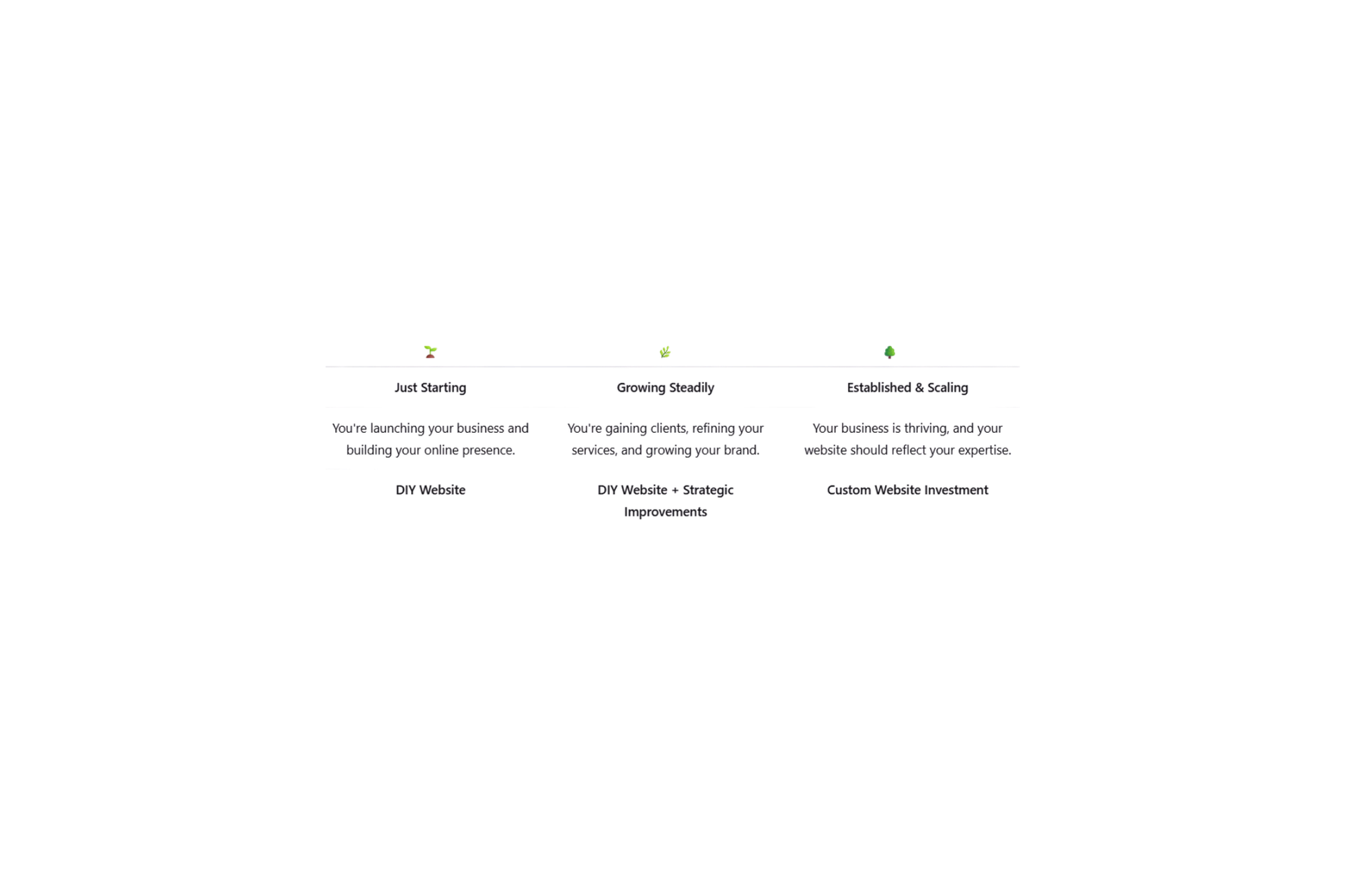
Stage 1: A DIY Website Is Often the Right Choice
When I first had a consultation call with Jessica from The Expat Coach, she was a little hesitant to show me the DIY website she had created 1 year ago through Canva. She explained that, at the time, her budget was very limited because she was still building her clientele through her marketing efforts.
Jessica also shared that while she loved coaching, she hadn't yet realized that she wanted to become an expat coach. Since she rarely saw that niche represented online, her DIY website simply described her as a coach who was passionate about travel and had been exploring the world from a young age as an army brat. In other words, Jessica hadn't yet established a well-defined niche when she first created her website.
Her branding had also been chosen from one of Canva's preset suggestions because she thought it looked cute. However, it didn't truly reflect her personality or the feeling she wanted to convey to her target audience.
At the time, Jessica's ultimate goal was simply to establish an online presence. She wanted people who discovered her through social media or Google to have a website where they could learn more about her one-on-one coaching service. Behind the scenes, like many coaches and wellness professionals, she was still refining her services, learning more about her audience, and gaining confidence in her business.
I appreciated Jessica's transparency during our conversation and reassured her that progress was far more important than perfection. So, what changed, you might ask?
Well, that DIY website helped her gain seven consistent clients within her first year. But as her business grew, she began feeling the need for a website that better reflected her growth, professionalism, and the direction her wellness business was heading.

Photo by Yan Krukau
Stage 2: Your DIY Website May Be Showing Its Limits
Jessica admitted during our discovery call that one of the benefits of having a Canva website was its low-cost upkeep—or at least that's how it seemed on the surface. Over time, however, she noticed that while many prospective clients were reaching out to her through her social media platforms, her Canva website analytics never really improved. While Canva websites can be a great starting point, they offer fewer SEO capabilities than a fully customized Squarespace website, which can make it more challenging to grow your visibility in search results as your business expands. In fact, Canva websites function much like landing pages, which can become limiting as your business grows while the template remains restrictive.
Jessica explained that she had an "aha!" moment when she noticed an unprecedented number of Instagram DMs from people who were interested in moving abroad. That's when she decided to use her expertise and niche down as an expat coach. Next, she consulted with a business coach who helped her develop her Signature Thrive Abroad™ coaching program and business branding.
After all of that hard work and the steady increase in inquiries, Jessica realized it was time to update her Canva website to reflect her new program and branding. However, she found herself spending hours troubleshooting, watching endless tutorials, and working within the limitations of the platform.
DIY Hidden Costs
• Time
• Missed opportunities
• Lost inquiries
• Inconsistent branding
At some point, the biggest cost often isn't money—it's the amount of time your DIY website continues to demand.

Photo by Pavel Danilyuk
Stage 3: It Might Be Time to Invest in a Custom Website
As I listened intently to Jessica's business journey and looked over her DIY wellness website, I could clearly see the pieces of the puzzle coming together. Her story helped me understand why she had reached the stage where she was ready to hire a web designer for a custom Squarespace website. In her current stage, I could see that Jessica had professional experience, confidence, structured pricing, a loyal client base, and consistent referrals coming in.
Yes, Jessica reached out to me because she knew I specialized in creating Squarespace websites for wellness professionals, which was the first step in the right direction. However, like Jessica, many coaches, therapists, psychologists, and other wellness professionals will eventually reach a point where they need to reflect on some important questions before making the transition to a professionally designed website.
If you're at this stage, here are some important aspects that you and your wellness website designer should review before the design process begins:
• A clear client journey: When a visitor lands on your website, what might they be feeling? How will you reassure them that they're in the right place? What solutions will you offer? How will your story resonate with them? How will you build trust until the moment they decide to reach out?
• A better user experience: Now that you're ready for an upgrade, how can your website navigation become cleaner, easier to use, and more user-friendly?
• A strong SEO foundation: There is someone out there searching for exactly what you offer—but what are they typing into Google to find you? Those search terms are known as keywords and are a key part of SEO (Search Engine Optimization). Everything from the wording throughout your website and blog posts to the file names of your images can help guide your ideal clients back to your business. A Squarespace web designer can strategically incorporate these keywords throughout your website to improve your online visibility.
• Professional branding: Unlike the DIY approach, a custom website allows you to develop a cohesive brand identity, including a professionally designed logo in various formats, professional photography, intentional brand colors, and typography. Together, these elements tell the unique story of your wellness business and evoke the feelings you want your clients to experience.
• Strategic messaging: A custom website also requires thoughtfully written copy that guides visitors through each section of your website with empathy, clarity, and purpose. Effective messaging helps build trust while naturally leading visitors toward taking action.
• Higher perceived value: A custom website should be viewed as an investment in your business. It should look polished, clean, and professional, with ample white space and a design that serves as a natural extension of the high-quality services you provide.
When these elements come together, your custom website becomes far more than an online brochure. It becomes a powerful marketing and sales tool that builds trust in your brand and creates meaningful connections with your ideal clients.

Photo by Chandra Diantara
7 Signs You've Outgrown Your DIY Website
Still on the fence about whether it's time to hire a web designer to transform your DIY website into a custom wellness website? Here are a few signs that you may be ready:
✔ You cringe when sharing your website.
✔ Your prices have increased.
✔ Your services have evolved.
✔ You want more Google traffic.
✔ Your branding no longer matches your website.
✔ You're attracting higher-paying clients.
✔ You'd rather spend time serving your clients than fixing your website.
A DIY website isn't something to be embarrassed about. In fact, many successful wellness professionals begin with one before investing in a custom website that reflects how far their business—and their expertise—has come.

Photo by Josh Willink
Final Thoughts
Whether you're a life coach, therapist, or another wellness professional, I hope Jessica's story and the stages we've explored have helped clarify when a DIY website makes sense. I also hope they have highlighted some of the key signs that indicate it's time for your website to evolve alongside your business.
If your DIY website no longer reflects the quality of your work, I'd love to help. At Nomadic Virtual Solutions, I design thoughtful, strategic Squarespace websites for wellness professionals who are ready to invest in a website that supports their business, builds trust, and helps convert visitors into clients. Reach out today to learn more about working together.